




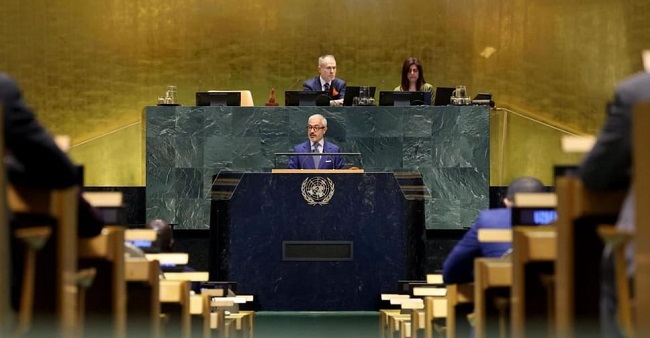
The United Nations General Assembly has adopted a resolution establishing a three-year cycle for global water conferences, in a move aimed at strengthening international cooperation and accelerating efforts to address water-related challenges.
The resolution, spearheaded by the United Arab Emirates (UAE) and Senegal, was adopted by consensus and will provide member states with a regular platform to review progress, set priorities and renew commitments towards improving global access to water and sanitation.
The decision comes ahead of the 2026 UN Water Conference, which the UAE and Senegal will jointly host in Abu Dhabi from December 8 to 10.
Under the new arrangement, the conferences will provide a continuous platform for governments and other stakeholders to assess progress and address challenges beyond the 2030 Agenda for Sustainable Development.
Previously, the United Nations had no fixed schedule for high-level conferences dedicated to water issues. The first UN Water Conference was held in 1977, while the second took place 46 years later, in 2023. Following the 2026 conference in Abu Dhabi, Tajikistan is expected to host the next edition in 2028.
The resolution is considered significant as water scarcity continues to affect millions of people worldwide. Approximately 2.1 billion people still lack access to safely managed drinking water, despite global efforts to achieve Sustainable Development Goal 6 (SDG 6), which seeks to ensure access to water and sanitation for all.
Speaking at the General Assembly, the UAE’s Permanent Representative to the United Nations, Mohamed Abushahab, said the resolution would create a more consistent approach to tackling global water challenges.
He said it would lay the foundation for stronger initiatives by member states and stakeholders to achieve universal access to water and sanitation while ensuring the sustainable management of water resources.
Similarly, the UAE Assistant Minister of Foreign Affairs for Energy and Sustainability, Abdulla Balalaa, said the decision would help sustain the momentum of the forthcoming Abu Dhabi conference.
According to him, a regular conference would ensure that international discussions and commitments on water continued beyond 2030 through stronger cooperation and sustained action.
The UAE Mission to the UN also described the adoption of the resolution as historic in a statement posted on X, noting that previous conferences had not followed a fixed schedule.
It said the decision would establish water as a continuous priority on the international agenda and allow countries to build on the outcomes of the December conference.
The 2026 UN Water Conference is expected to attract governments, investors, businesses, scientists, innovators, young people and civil society organisations.
The gathering will focus on mobilising resources, strengthening partnerships and developing practical solutions to global water challenges, with particular attention to financing, technology and innovation.
It will also seek to address the global water investment gap by mobilising the funding, expertise and technical solutions needed to improve access to water and accelerate the implementation of existing commitments.
The conference will operate through two platforms: the official UN-accredited Blue Zone and The Oasis, a UAE-hosted platform open to all participants.
The Oasis will provide space for exhibitions, high-level discussions and engagement among stakeholders, with the aim of showcasing innovations and encouraging collaboration on water-related solutions.
Reacting to the General Assembly’s decision, the Chief Executive of WaterAid UK, Tim Wainwright, described the resolution as an important step towards giving water issues greater international attention and accountability.
He noted that water was essential to public health, climate resilience and economic development but had not received the level of global attention it deserved.
Wainwright congratulated the United Nations for establishing a regular platform that would maintain political commitment and strengthen accountability towards achieving universal access to water, sanitation and hygiene.
He also expressed hope that the Abu Dhabi conference would help translate global commitments into lasting improvements in access to clean water for current and future generations.
The new three-year conference cycle is expected to improve international coordination by giving governments and stakeholders regular opportunities to evaluate progress, identify gaps and strengthen their commitments towards achieving global water and sanitation targets.


