




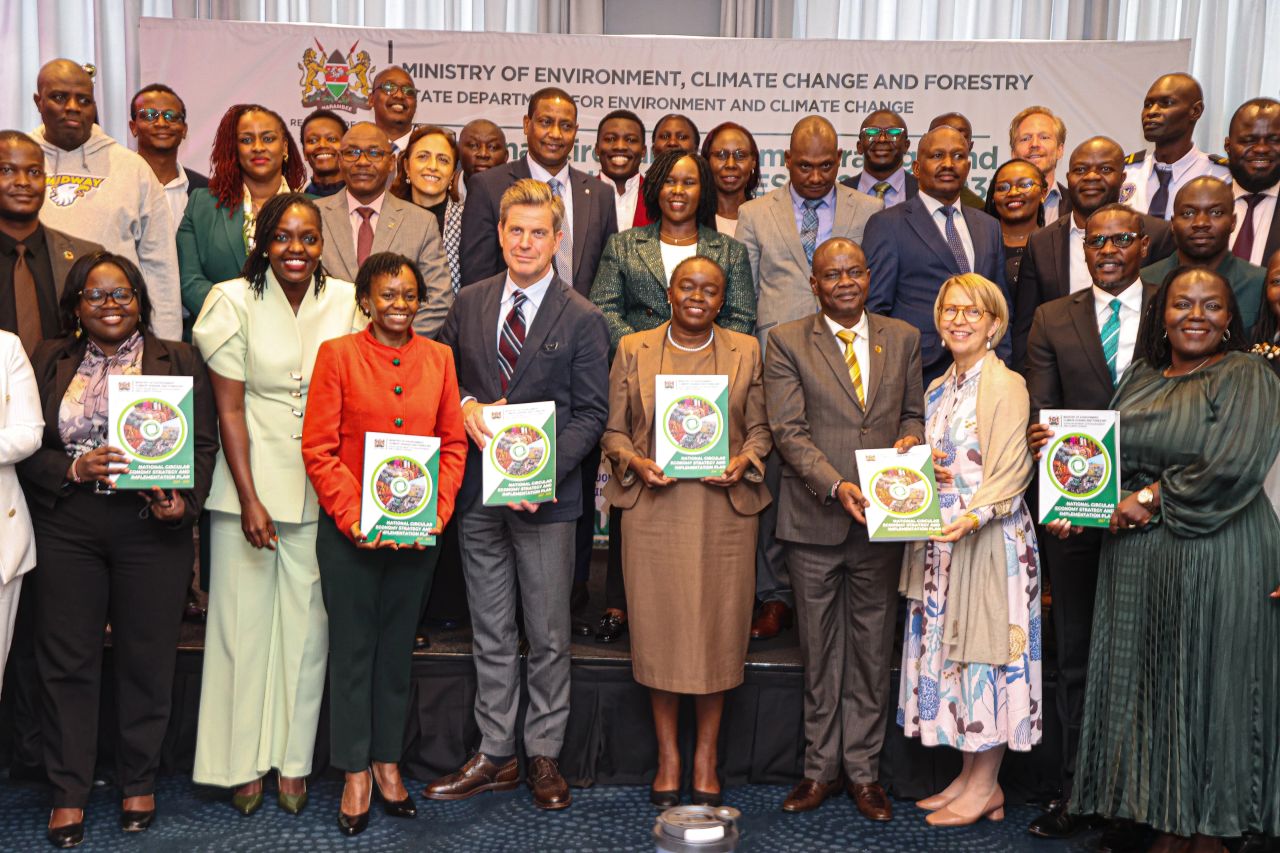
Kenya has launched its National Circular Economy Strategy and Implementation Plan (CESIP) 2027-2032, a five-year roadmap that aims to move the country away from the “take-make-dispose” model and towards reuse, recycling and resource recovery.
The plan which was launched on Tuesday, 24 November 2026, under the theme “Transforming Waste into Wealth for a Sustainable, Resource-Efficient and Prosperous Kenya” brought together national and county governments, ambassadors from Denmark and Finland, development partners, the private sector and other stakeholders.
Speaking during the launch in Nairobi, Forestry Cabinet Secretary, Dr. Deborah Barasa, who was the Chief Guest said the strategy was an economic transformation agenda that would create new markets, attract green investments, strengthen local manufacturing and generate employment while reducing environmental pollution.
She noted that Kenya generates an estimated 0.5 kilogrammes of waste per person daily, with packaging materials accounting for nearly 30 per cent of municipal solid waste, underscoring the need for sustainable waste management systems.
The strategy targets five key sectors: agriculture and food systems, plastics and packaging, electrical and electronic equipment, textiles and fashion, as well as mining, quarrying and construction.
According to the strategy, 40 per cent of the food Kenya produces never reaches the plate, only 9 per cent of plastic is recycled, less than 5 per cent of e-waste is formally recycled, and just 1 per cent of textiles is recycled. Project partners also say the country generates between 22,000 and 24,000 tonnes of waste every day, with more than 75 per cent of it poorly managed.
Barasa called for coordinated efforts between national and county governments, the private sector, development partners and local communities, saying the 47 county governments would play a critical role in establishing waste recovery infrastructure and implementing the strategy.
She also emphasised the need to integrate waste pickers, informal recyclers, women, youth and small enterprises into the initiative to ensure they benefit from emerging economic opportunities.
Principal Secretary for Environment and Climate Change, Dr. Eng. Festus Ng’eno, said CESIP brings previously scattered initiatives under one national framework with clear responsibilities, financing mechanisms and accountability measures. In a post on LinkedIn after the event, he said the strategy is firmly aligned with the Bottom-Up Economic Transformation Agenda (BETA), which prioritises inclusive growth, value addition, job creation and better livelihoods. He said that by turning waste into valuable resources, CESIP offers communities, businesses and young people a way to take part in the green economy.
Dr. Ng’eno stressed that implementation will decide the strategy’s success. “The true measure of CESIP will be its implementation,” he said, adding that county governments have a pivotal role. They will have to build circular economy measures into county policies, laws, budgets and development plans, and invest in local waste recovery and recycling infrastructure. “This is where national ambition must translate into tangible opportunities and impact at the grassroots,” he said.
The rollout will happen in phases. The government will use 2027 for institutional coordination and preparation, and the main five-year operational period will run from 2028 to 2032. The plan also targets the certification of 15,000 informal-sector workers by 2032, recognising the role waste pickers and other informal players already play in collecting and recycling waste. It also seeks to attract investment into recycling, waste recovery and other green businesses.
CESIP was commissioned by the Ministry of Environment, Climate Change and Forestry and developed with the Kenya Private Sector Alliance (KEPSA) and an Intellecap-led consortium. Dr. Ng’eno thanked the development partners behind the process, naming the European Union, the Embassies of Finland and Denmark, Sitra, KEPSA, Intellecap and Global Gateway.
With the launch done, the focus now moves from policy-making to delivery. Industry players, county governments and development partners will be watching how quickly the financing is mobilised and how the strategy’s targets are met from 2028.


