




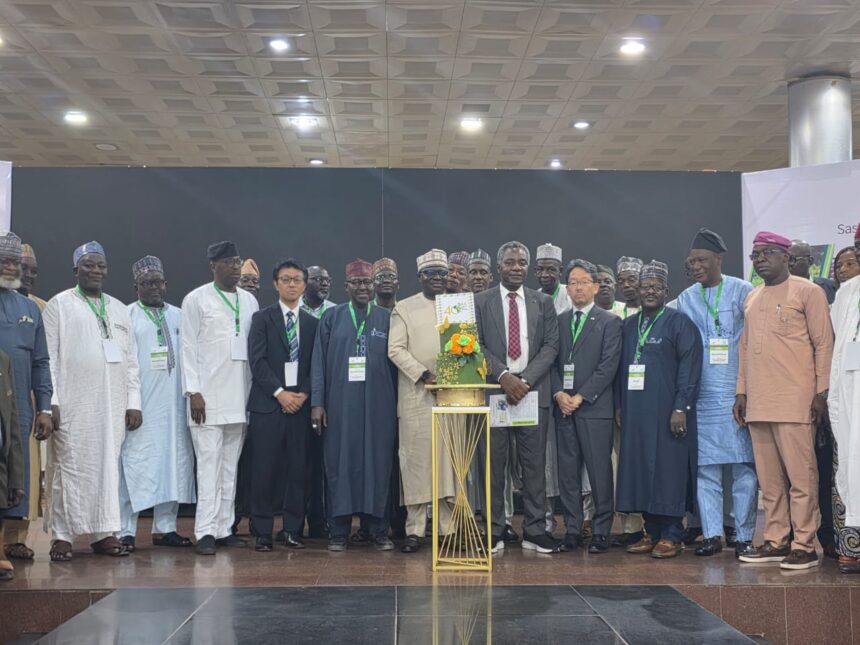
The Federal Government, Japan, and development partners have intensified efforts to scale investment, deepen mechanisation, and strengthen agricultural value chains to reposition Nigeria’s agriculture sector for productivity-led growth.
This formed the focus of discussions at the Sasakawa Africa Association (SAA) 2026 Annual Stakeholders’ Workshop, tagged SAA@40, held recently in Abuja.
Stakeholders at the event emphasised the need to transition from project-based interventions to system-wide transformation, with priority on finance, technology deployment, and market integration.
President of the Sasakawa Africa Association, Shuichi Suzuki, said the next phase of agricultural intervention must focus on measurable outcomes and sustainability.
He noted that while the organisation has scaled its impact over four decades, future efforts would prioritise quality of outcomes, sustainability of innovation, and long-term systemic change.
Suzuki added that long-term partnerships and adaptability to global challenges, including COVID-19 and climate change, have been central to the association’s growth.
He called for stronger collaboration among stakeholders, stressing the importance of public-private partnerships, data-driven monitoring, and strategic investment.
Country Director of SAA Nigeria, Godwin Atser, said Nigeria still faces a significant gap between food production and consumption, noting that the country spends about $10 billion annually on food imports.
Atser attributed the gap to weak agricultural extension systems and limited access to modern technologies, calling for improved advisory services to farmers.
Representing the Minister of State for Agriculture and Food Security, Aliyu Sabi Abdullahi, the Permanent Secretary, Marcus Olaniyi Ogunbiyi, said agriculture remains central to Nigeria’s economic diversification, food security, and job creation efforts.
He described SAA as a key partner in improving productivity and livelihoods of smallholder farmers, citing interventions in regenerative agriculture, nutrition-sensitive farming, and market-oriented production.
The government also highlighted ongoing reforms, including the development of the Soil Health Card and Nigerian Soil Information System, integration into the ECOWAS Regional Fertilizer Hub, and provision of laboratory equipment across 12 states.
According to the ministry, these efforts are attracting both local and international investments into Nigeria’s agricultural value chains.
Japan’s Ambassador to Nigeria, Suzuki Hideo, said modernising agriculture is critical to Nigeria’s sustainable economic development.
He noted that the sector, which employs about 34 per cent of the labour force and contributes roughly 25 per cent to GDP, requires improved mechanisation, reduced post-harvest losses, and stronger market linkages.
The envoy added that Japan would continue to support Nigeria through technology transfer and technical expertise.
Chief Representative of the Japan International Cooperation Agency, Ishigame Keiji, said Nigeria’s agricultural constraints remain largely structural, including low productivity, reliance on manual labour, and limited access to modern inputs.
He explained that ongoing interventions aim to strengthen the entire food system, from production and inputs to finance and market access.
Keiji disclosed that Japan is supporting rice seed production systems and exploring an Agricultural Finance Two-Step Loan to provide long-term funding to agribusinesses, cooperatives, and smallholder farmers.
He added that mechanisation should be treated as a strategic driver of productivity and resilience rather than merely the distribution of equipment.
Stakeholders at the workshop agreed that Nigeria’s agricultural transformation is entering a new phase driven by scale, capital investment, and systems integration, with stronger alignment among government, development partners, and the private sector.


