




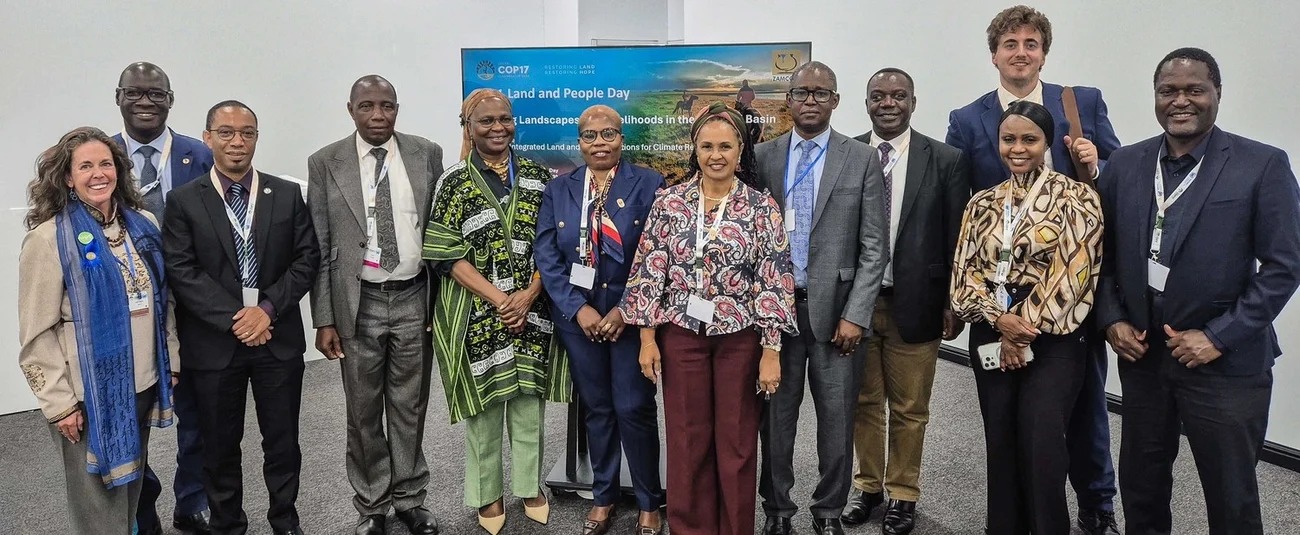
Participants at the UNCCD COP17 have called for comprehensive investments in the Zambezi River Basin to restore landscapes, strengthen livelihoods and build climate resilience across the eight countries that form the basin of Africa’s fourth-largest river.
Around 44% of the 51 million people living in the basin, which covers approximately 1.37 million square kilometers, live below the poverty line. The basin’s economies are increasingly vulnerable to flooding and drought, infrastructure gaps and environmental degradation, with 51% of the land moderately degraded.
The call came during “Restoring Landscapes and Livelihoods in the Zambezi Basin: Scaling Up Integrated Land and Water Solutions for Climate Resilience,” an event on the sidelines of COP17 that brought together leaders of governments, development partners, climate finance institutions, civil society and regional bodies to discuss how to scale solutions across the basin.
Representing the African Development Bank, Division Manager for Agricultural Research, Production and Sustainability Laouali Garba stressed that mobilising finance would require investments that address multiple development priorities simultaneously.
“Integrated projects with multiple purposes — land restoration, agricultural production, community resilience, ecotourism and job creation — are more attractive for public and private sector investment than standalone nature-based solutions,” he said.
Participants discussed PIDACC Zambezi, an African Development Bank supported initiative that also draws in the Zambezi Watercourse Commission (ZAMCOM) and other partners to advance integrated land and water management, ecosystem restoration and climate-resilient livelihoods. Garba highlighted the initiative as an example of a successful approach, one that combines public resources with grants, concessional finance and support from development partners and climate funds to crowd in investment from the private sector.
These efforts are being scaled through the Climate Investment Funds-supported Zambezi Region Nature, People and Climate (NPC) Investment Plan.
Laurent Frapaise, a natural resources management consultant with the World Bank, stressed that the Zambezi basin should be viewed as an integrated development challenge involving societies, economies and different government sectors. He emphasised the need for investments that are not only bankable, but also sustainable, and for stronger coordination across ministries.
The event also highlighted the “Strengthening Zambezi River Basin Management towards Climate Resilience and Ecosystem Health” project, for which the African Development Bank secured Global Environment Facility financing. The project aims to strengthen integrated Water-Energy-Food-Environment (WEFE) planning, ecosystem resilience and transboundary basin management. Together, these efforts contribute to the Southern African Great Green Wall Initiative, while supporting broader efforts to strengthen water security, land restoration and drought resilience across the region.
The panel also explored how public resources can reduce risks and attract private capital through public-private partnerships, guarantees, risk-sharing instruments and concessional credit for small and medium-sized enterprises investing in land restoration, agroforestry and sustainable value chains.
Participants argued that communities have a key role to play.
Prof. Hesphina Rukato, of the Centre for African Development Solutions, stressed that gender-responsive investment requires recognizing that women are not a homogeneous group.
“Whether women benefit from investments depends on what access and control they have over the resources,” Rukato said.
She also called for targeted approaches to ensure women can participate effectively in planning and implementation and benefit equitably from restoration investments.
Participants also urged that governments, development finance institutions, climate funds, the private sector, civil society and river basin organisations collaborate more closely to drive a shift towards integrated, bankable and sustainable investments at scale.
Source: https://www.afdb.org/


