




The need to place adequate housing at the centre of inclusive, sustainable and resilient cities came under the spotlight today as the United Nations marked the 40th observance of World Habitat Day.
“Adequate housing is the foundation of dignity, security, and opportunity. Yet more than 3 billion people are denied this universal human right. Investing in adequate housing and transforming informal settlements reduces poverty, tackles inequality, builds climate resilience, and fosters peaceful and inclusive societies,” UN Secretary-General António Guterres said in his video statement for the occasion.
Speaking at the global observance in Muscat where UN-Habitat, in partnership with the Government of Oman, marked the Day, Anacláudia Rossbach, Executive Director of UN-Habitat, said: “Adequate housing is not a luxury. It is a foundation for a dignified life and for sustainable cities.”
“We have seen that progress is possible,” she continued. “But the scale of the challenge requires us to do more, and to do it differently: by putting people at the centre of housing policies, investing in communities and working across levels of government and with the private sector and civil society. Adequate housing is not a luxury. It is a foundation for a dignified life – and for sustainable cities. On World Habitat Day, this is the future we should be building: adequate housing for all.”
In a video message to the event, the President of the UN-Habitat Assembly, Nga Kor Ming, who also serves as Malaysia’s Minister of Housing and Local Government, highlighted how the fundamental right to shelter and housing is coming under tremendous pressure.
“Adequate housing is not a luxury – it is a fundamental human right. The basis for human development, healthcare, economic opportunity, and social stability,” Mr. Ming said.
He added that to deliver ‘Adequate Housing for All,’ the world must move away from quick fixes to systemic transformation, and this could be achieved by treating housing as a public good, upgrading informal settlements, and aligning with global frameworks so as to achieve global housing targets listed under the Sustainable Development Goals (SDGs) and the New Urban Agenda.
A dire situation
This year’s World Habitat Day global observance was held under the theme ‘Adequate Housing for All,’ highlighting the importance of adequate housing as a foundation for inclusive, sustainable and resilient cities.
Currently, the global housing situation is dire. In its World Cities Reports 2026, UN-Habitat estimates that up to 3.4 billion people lack adequate housing.
At the same time, the SDG 11 Global Report 2026, published by UN-Habitat with partners across the United Nations system, indicates that the world remains far off track to achieve SDG 11, with the number of people living in informal settlements and slums having grown by more than 130 million since 2015, to over 1.1 billion.
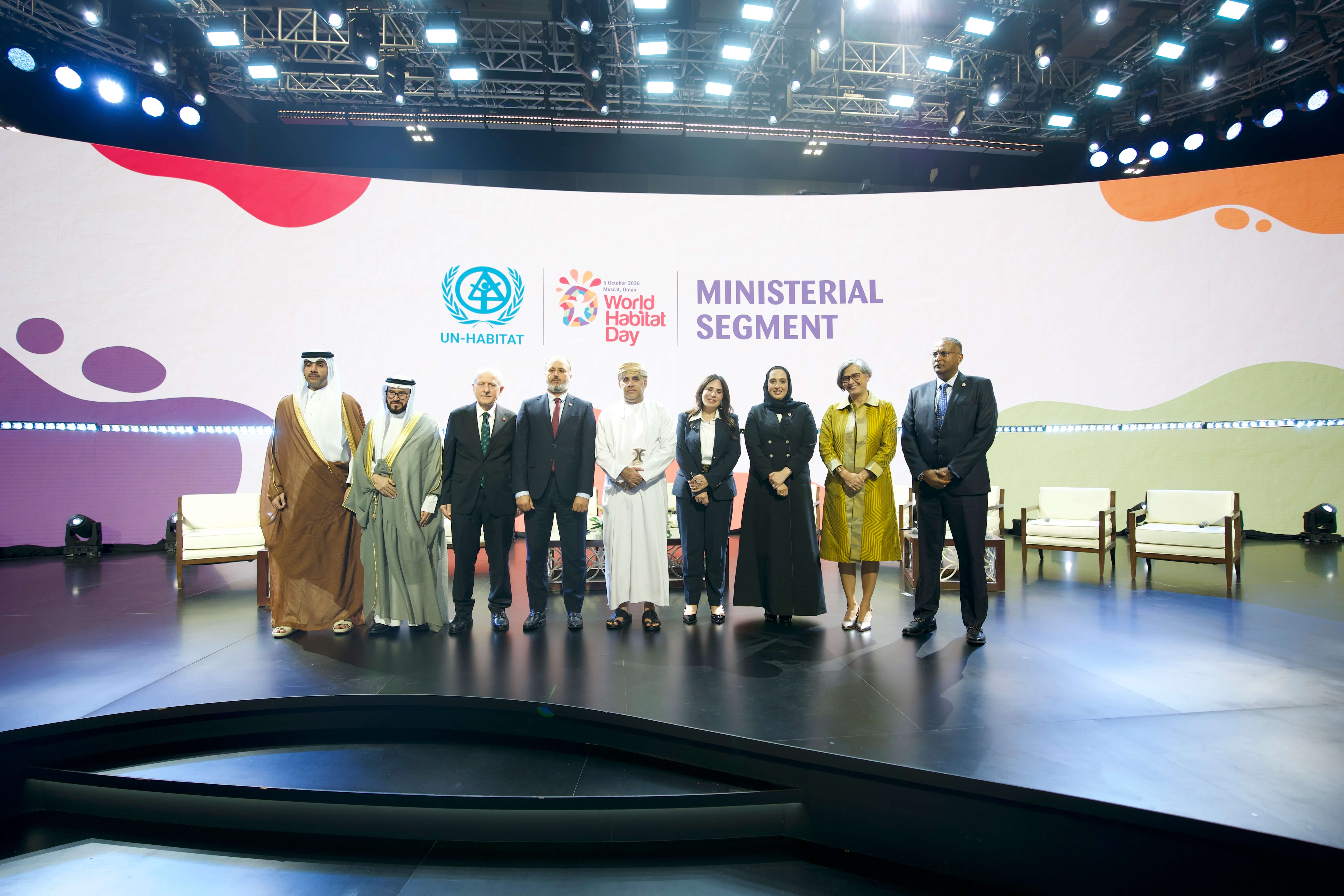
The observance brought together more than 800 government officials, city leaders, urban experts, civil society and private sector representatives to discuss how to make housing more accessible and affordable, while strengthening cities and communities. A ministerial segment brought together ten ministers and deputy ministers from Bahrain, Egypt, Libya, Kuwait, Pakistan, Oman, Qatar, Somalia, Türkiye and the United Arab Emirates.
Scroll of Honour Award
The gathering in Oman also served as an opportunity to recognize the five winners of the 2026 UN-Habitat Scroll of Honour Award, which recognizes individuals and institutions whose work contributes to improving adequate housing, sustainable urbanization and urban life, and to advancing the New Urban Agenda and the 2030 Agenda for Sustainable Development.
This year, UN-Habitat received 101 nominations from across Africa, Asia, Europe and the Americas. The winners were Housing NOW of Bago, Myanmar; Abdelmalek Ghannem of Bizerte, Tunisia; Aldeia do Espraiado – Tekoa Ara Hovy of Maricá, Brazil; the Punjab Housing and Town Planning Agency of Lahore, Pakistan; and Mayor Sadiq Khan of London, the United Kingdom.

The five winners reflected the range of approaches needed to advance adequate housing and sustainable urban development – from innovative building materials and affordable housing to housing solutions for communities affected by displacement and conflict, and culturally appropriate housing for Indigenous communities.
“This year’s winners prove that the global housing crisis is not beyond our reach – whether they are expanding affordable homes in major cities, turning waste into building materials or giving displaced and Indigenous communities a secure place to live, each of them puts people and their right to a home at the centre of urban development,” Ms. Rossbach said.
Global celebrations
Away from Muscat, World Habitat Day was marked in more than 10 countries, including Afghanistan, Cameroon, Cabo Verde, Mozambique, India, Pakistan, Thailand and Sri Lanka.
In Asia and the Pacific, celebrations took place across Bangladesh, India, the Islamic Republic of Iran, Nepal, Pakistan, the Philippines, Sri Lanka and Thailand. Discussions on adequate housing will continue through Urban October, with National Urban Forums scheduled in Malaysia, Lao PDR and Viet Nam.
In Lusophone countries, a webinar on the role of technical assistance for social housing in Mozambique and Cabo Verde was also held as part of the wider discussion on adequate housing.
World Habitat Day marks the start of UN-Habitat’s Urban October campaign, which brings together events and activities around the world to advance dialogue and action on adequate housing and sustainable urban development. More than 99 events are currently registered, with the campaign culminating in World Cities Day on 31 October.
Source: https://unhabitat.org/


