




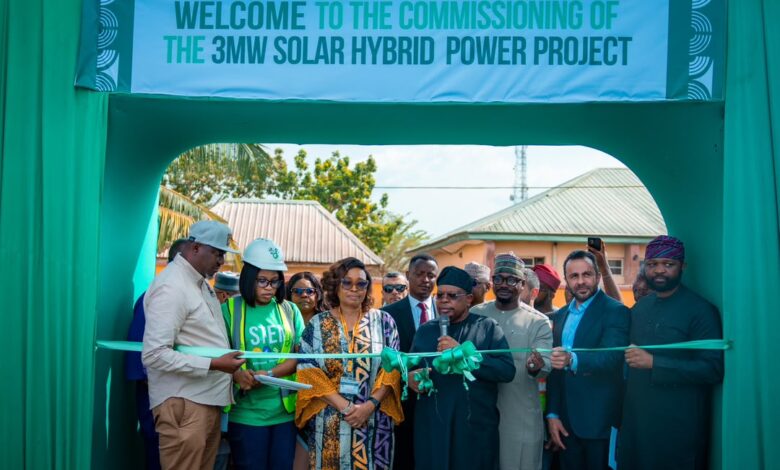
The Minister of Power, Joseph Tegbe, has commissioned a 3.0-megawatt (MW) solar hybrid power project at Michael Okpara University of Agriculture, Umudike, Abia State, as part of efforts to improve electricity supply to public institutions and strengthen renewable energy adoption.
The project was delivered under Phase II of the Energising Education Programme (EEP), funded by the World Bank and implemented by the Rural Electrification Agency (REA). The programme covers seven Nigerian universities and two teaching hospitals across the country’s six geopolitical zones.
Speaking at the commissioning, Tegbe said the Federal Government was committed to transforming electricity from a constraint on economic growth into a dependable driver of national development.
He explained that the government’s approach combined stronger grid infrastructure with renewable and distributed energy systems designed to meet the needs of different communities and institutions.
“Universities, healthcare facilities, and productive centres require solutions that respond to their actual needs,” he said.
The Abia State Governor, represented by the Commissioner for Power, Hon. Ikechukwu Monday, described the EEP as excellent in conception and dynamic in relevance.
He thanked the Federal Government for its commitment to expanding electricity access across the state, noting that the project would benefit lecturers, students and scientific researchers.
Also speaking, the Managing Director of REA, Dr Abba Aliyu, said the facility comprised a 3MW solar hybrid power plant, 2.2 megawatt-hours (MWh) of battery energy storage, rehabilitated distribution infrastructure, streetlights and a renewable energy training centre.
He said the intervention would support uninterrupted research, agricultural innovation, extended learning hours and entrepreneurship among students.
Aliyu disclosed that the Energising Education Programme had delivered energy infrastructure across 22 federal universities and three affiliated teaching hospitals, with more than 100MW of installed capacity, benefiting over 600,000 students and 50,000 academic and non-academic staff.
He added that the programme had also provided practical renewable energy training to 140 female students in science, technology, engineering and mathematics under Phase II.
The REA managing director further highlighted the Federal Government’s broader renewable energy expansion efforts through the completed Nigeria Electrification Project, which delivered 198 mini-grids and facilitated the deployment of approximately 1.4 million solar home systems.
He said the agency was also implementing the $750 million World Bank-supported Distributed Access through Renewable Energy Scale-up (DARES) programme, targeting electricity access for 17.5 million Nigerians through approximately 1,350 mini-grids.
“Our ambition is not just to be a consumer, but to position Nigeria as a manufacturer and exporter of solar technology. I envision a future where some of the renewable energy tech deployed on this project is produced in Abia State. A powered university must produce graduates and also produce solutions,” he said.
Earlier, the Vice-Chancellor of the university, Prof. Ursula Ngozi Akanwa, said reliable electricity was essential to the institution’s teaching, research and agricultural development activities.
She noted that laboratories, workshops and research facilities depended on stable power supply, particularly as technological innovation continued to transform food production, processing and preservation.
Akanwa pledged the university’s commitment to proper management of the facility and responsible electricity consumption.


