




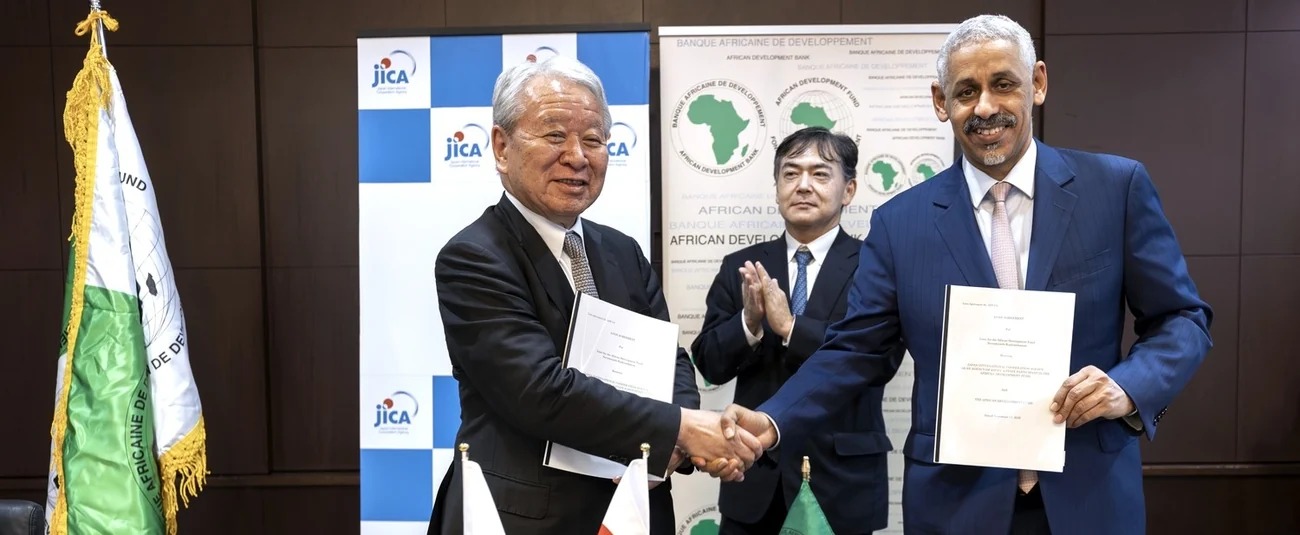
Japan has signed a $583.4 million concessional loan agreement with the African Development Bank Group (AfDB) to strengthen development financing for Africa’s poorest countries.
The agreement, signed between the African Development Bank Group and the Japan International Cooperation Agency (JICA), involves a loan of JPY 86.6 billion to support the African Development Fund’s (ADF) seventeenth replenishment, known as ADF-17.
The signing took place in Tokyo on November 13, with the President of the African Development Bank Group, Dr Sidi Ould Tah, and JICA President, Dr Akihiko Tanaka, representing both institutions.
The financing is expected to increase access to affordable, long-term funding for low-income African countries facing major development challenges. It will support investments in critical infrastructure, energy access, food security and regional integration, while creating more economic opportunities across the continent.
Speaking at the signing ceremony, Tanaka described the agreement as a reflection of the strong partnership between JICA and the African Development Bank Group and their shared commitment to Africa’s development.
He noted that the loan represents JICA’s largest-ever Official Development Assistance (ODA) financing support to the African Development Fund, demonstrating Japan’s confidence in ADF-17’s capacity to address Africa’s interconnected development challenges.
According to him, the financing will help African countries advance resilient, inclusive and sustainable development.
Also speaking, Ould Tah disclosed that ADF-17 had mobilised a record $11 billion in contributions from 44 development partners.
He, however, stressed that the Fund’s ambition goes beyond raising financial resources, noting that the Bank Group is working to transform how Africa mobilises and deploys development finance through its New African Financial Architecture for Development.
Japan’s latest financing commitment fulfils a pledge made by its Ministry of Finance during the ADF-17 replenishment pledging session in December 2025.
It also complements Japan’s existing contributions to the Fund, including grants and compensation under the Multilateral Debt Relief Initiative, which together amount to approximately $600 million.
Japan’s Deputy Vice Minister for International Affairs at the Ministry of Finance, Kazuki Watanabe, said the country expects ADF-17 to deliver measurable development outcomes.
He highlighted the importance of expanding quality infrastructure, strengthening governance and institutional capacity, and promoting sustainable debt management across African countries.
The Tokyo agreement follows an earlier signing ceremony held on November 5 at the African Development Bank Group’s headquarters in Abidjan, Côte d’Ivoire.
During the ceremony, the Bank Group’s Vice-President for Finance and Chief Financial Officer, Hassatou Diop N’Sele, and Japan’s Ambassador to Côte d’Ivoire, Junji Gomakubo, signed and exchanged official diplomatic notes, marking an important step towards formalising Japan’s financing commitment to ADF-17.
Japan has maintained a longstanding relationship with the African Development Bank Group, having joined the African Development Fund in 1973 and the African Development Bank in 1982.
Over the years, the partnership has covered concessional financing, private sector investment, human capital development, technical assistance and knowledge exchange.
The ADF-17 replenishment also represents a new direction in the Fund’s approach to development financing, with a stronger focus on investment-driven funding.
Through innovative financial instruments, including concessional loans from donor countries and a new market borrowing framework, the Fund intends to leverage its existing resources to attract additional capital.
The approach is designed to maximise the impact of donor contributions and expand access to affordable, long-term financing for eligible African countries.
Established in 1972, the African Development Fund is the concessional financing arm of the African Development Bank Group. It provides grants and low-interest loans to eligible African countries to support economic growth and social development.


