




Corporate Social Responsibility should be a vehicle for Sustainable long-term solutions rather than an avenue for corporate organizations to tick the box. These were the submissions of Muhammed Bukar Umara at the panel, “Centering Local Voices and Community-Led Solutions for Children and Marginalized Groups”, at the just concluded Africa Social Impact Summit 2025 held at Eko Hotel and Suites.
Moderated by Jonathan Abakpa, Advocacy and Youth Programme Officer at Plan International, the panel discussion focused on the significance of involving local communities in decision-making processes to ensure that solutions are tailored to their specific needs.
The panel discussion, which had a majority of young people, was aimed at amplifying the voices of local communities. They emphasized prioritizing the needs and perspectives of local communities and creating sustainable solutions that benefit children and marginalized groups.
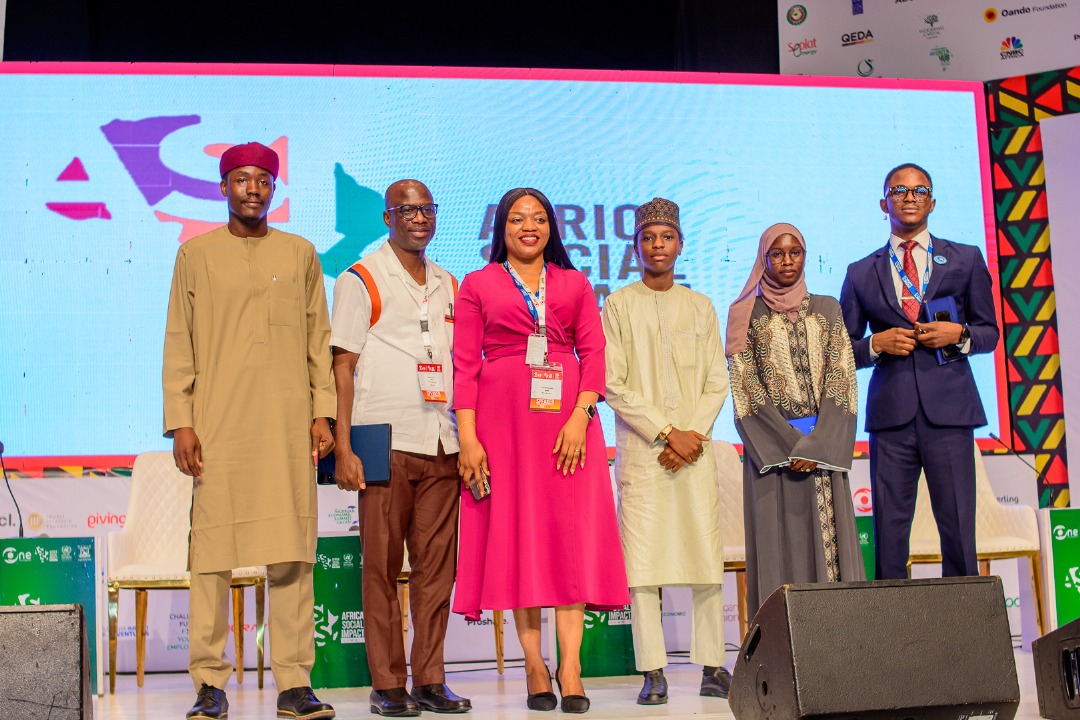
The panelists included Mohammed Bukar Umara, Chief Executive, Co-Development Hub; Fatima Muhammad Mafi, Girl Child Activist; Hon. Ibrahim Zanna Sunoma, Deputy Speaker at National Children’s parliament; Oladeji Olayemi, National Project Officer (Education for Health and Wellbeing UNESCO, Nigeria); Tobi Ransomed, Education Specialist, Plan International.
Mohammed Umara discussed the need for sectors to stop doing CSR for communities, but with communities, so as not to just tick the box but provide sustainable solutions.
“I would like to use this platform again to call on private sector, especially as this is an event that is led by private sector impressively, to look at something like the private sector CSR coordination platform, which is something similar to the humanitarian clusters in Waterview, to ensure that CSR are not just for ticking the box, which is basically what a lot of, I’m sorry to say, what a lot of private sector individuals are doing to tick the box, but it’s beyond that. It’s people, it’s problems, it’s solutions, solutions that are long-term, that are sustainable and doable solutions, not just solutions for the sake of ticking the box”
“I think this is more than ever the best time that the private sector needs to step in. And in doing so, not just to step in as a substitute of aid, but as a long-term development partner. And that starts from, first of all, having a mindset shift in the private sector itself to stop seeing CSR initiatives as just charitable acts, but as a responsibility that it is”
“Today, you see a lot of CSR initiatives happening across Nigeria, particularly in the Northeast where I come from, but there’s still no coordinated effort to making sure that these CSR initiatives achieve the highest impact that they should, which is what calls for something like the private sector CSR coordination platform, just like we have in the humanitarian development sector, with clusters and sub-sectors that make sure that resources that are allocated for humanitarian efforts are well-coordinated, and their results are achieved at the maximum level”
This is something that needs to happen within the private sector industry, because the private sector is one large industry that can probably solve most of the issues we have in this country, with or without aid. But to what effort, to what extent are these resources coordinated in such a way that they reach the right audience? Now, the sector must stop doing CSR for communities, but with communities, because in the end, it’s not how much is spent, but where it was spent, and with whom it was spent, and for whom.
“But he also spoke about policy implementations beyond the bureau, beyond passing of bills, beyond having these beautiful frameworks. How do we implement them? How do we coordinate them in such a way that it’s beyond the paperwork, but it’s actual actions? And just like, I think, the UNDP rep said, bold actions are not just mere rhetorical aspirations, but actual action in the sense that it touches the people, it touches the community. So, I can’t agree less with him that the private sector is more than ever the best fit to be able to fill those gaps that have been created by shrinking of the funding, which is the reality that we all have to accept”, he said.
Ibrahim Zanna Sunoma stressed the importance of prioritizing young people and amplifying the voices of local communities, particularly children and young people.
“We need to prioritize young people, especially when it comes to the issue of conflict, because we suffer the most because of our vulnerability. And I believe the situation is still very devastating, and all eyes need to be on our young people, especially in Africa, to protect”, he said.
Fatima Muhammad Mafi emphasized the meaning of amplifying the voices of the marginalized groups. She said, “What it means to amplify our voices is to give us the platform to speak for ourselves. That is first. And second thing, what it means for us to actually work with the grassroots is actually to carry them along. So, unlike so many of you in this room, I’m one person that have seen what insurgency or conflict could do to girls”
“So, if you want to amplify the voices of young people, if you want to really work and protect girls, at the same time, keeping them safe, for them amplifying their voices, for you to give them the space that makes them feel safe. So, in this room today, I will say I am safe, once again, to some extent, I’m not, because I return to where I come from”
“One of the rights that we all do is rights to life. For us in the past, that was a privilege, because we all have run maybe once or twice to survive, and then now we’re trying to make a new country, which we’re trying to work with grassroots”
“We’re trying to amplify voices of victims of violence and abuse. So, to amplify our voices, as I said, is to give us the platform, and what platforms are we looking for? Platforms that give us agency, not just to speak, but to act. We carry ideas” she said.
Tobi Ransomed emphasized the critical role of education in promoting social impact and empowering marginalized communities. “Thank you to our amazing panelists for just speaking truthfully, vulnerably, and honestly to the world. Because for us to make any headway on any issue, there needs to be the openness and the willingness to share our experiences, and also share from the standpoint of finding solutions.
“And that is what I have been experiencing, and just generally, during the summit. So, when we say engagement across different partners, I think the number one thing we need to start from is agreement. Agreement on what the issues are, and then agreement on what the solutions are”
“So, for example, when we look at education, we all agree that there is a rising number of out-of-school children. We agree that this is an issue, but we may contend around the numbers. Like you rightly said, if you speak to one group of people, it is million, million”
“But we cannot stay on the contentions. Rather, agree on what needs to be done. Are there faces behind these numbers? Absolutely”, he said.


