




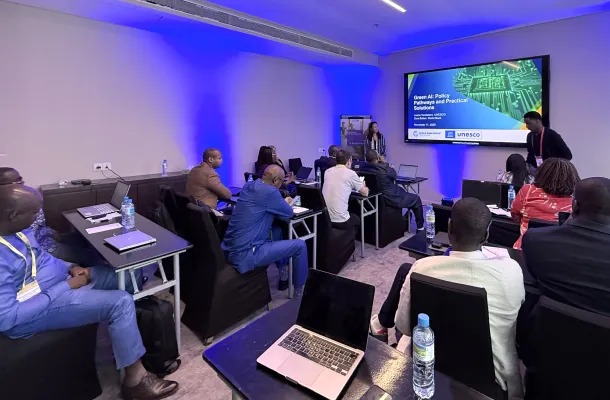
As African countries race to roll out national artificial intelligence strategies, UNESCO and the World Bank are urging governments to rethink how digital transformation intersects with environmental sustainability.
At a high-level workshop held on recently, ICT ministers and regulators from across the continent examined new evidence showing that without deliberate policy choices, AI could deepen pressure on already strained energy, water and land resources.
The meeting centred on findings from UNESCO’s report Smarter, Smaller, Stronger, which warns of a growing paradox: while AI is increasingly promoted as a tool to accelerate progress towards the Sustainable Development Goals, the data centres and computing infrastructure that underpin it are resource-intensive and carbon-heavy.
To address this challenge, experts outlined two complementary approaches. The first, known as “Greening AI”, focuses on reducing the environmental footprint of AI systems themselves. Research presented at the workshop showed that task-specific Small Language Models can deliver up to 90% energy savings compared to large, general-purpose models, while still performing effectively in areas such as public administration and agriculture. These “frugal AI” solutions are particularly relevant for Africa, where electricity costs are high and power supply remains unreliable in many regions.
The second approach, “Greening with AI”, highlights how artificial intelligence can actively support climate and environmental objectives. Case studies from Nigeria and East Africa demonstrated the use of machine learning to improve water resource management and to strengthen early warning systems for floods and extreme weather events.
The World Bank stressed that such innovations will only be sustainable if supported by coherent, cross-sector policies that connect digital governance with energy, mining and environmental regulation.
Framed as a contribution to the African Union’s Agenda 2063, the initiative positions Green AI as a pathway to climate-resilient growth. UNESCO reaffirmed its commitment to supporting African governments with policy frameworks and capacity-building, arguing that the continent’s digital future must be both technologically ambitious and environmentally responsible.


