




Africa contributes less than four per cent of global greenhouse gas emissions, according to the United Nations, yet remains one of the regions most vulnerable to climate change. From prolonged droughts in the Horn of Africa to recurring floods across West Africa, climate change continues to threaten livelihoods, food production and economic growth. Ironically, the continent also possesses vast agricultural potential and many of the critical minerals expected to power the global energy transition, including cobalt, lithium and manganese.
As governments, businesses and investors place greater emphasis on sustainability, conversations around Environmental, Social and Governance (ESG) have expanded beyond environmental advocacy to include investment, regulation and economic development. Investors now pay closer attention to how organisations manage environmental and governance risks, while regulators continue to strengthen sustainability disclosure requirements.
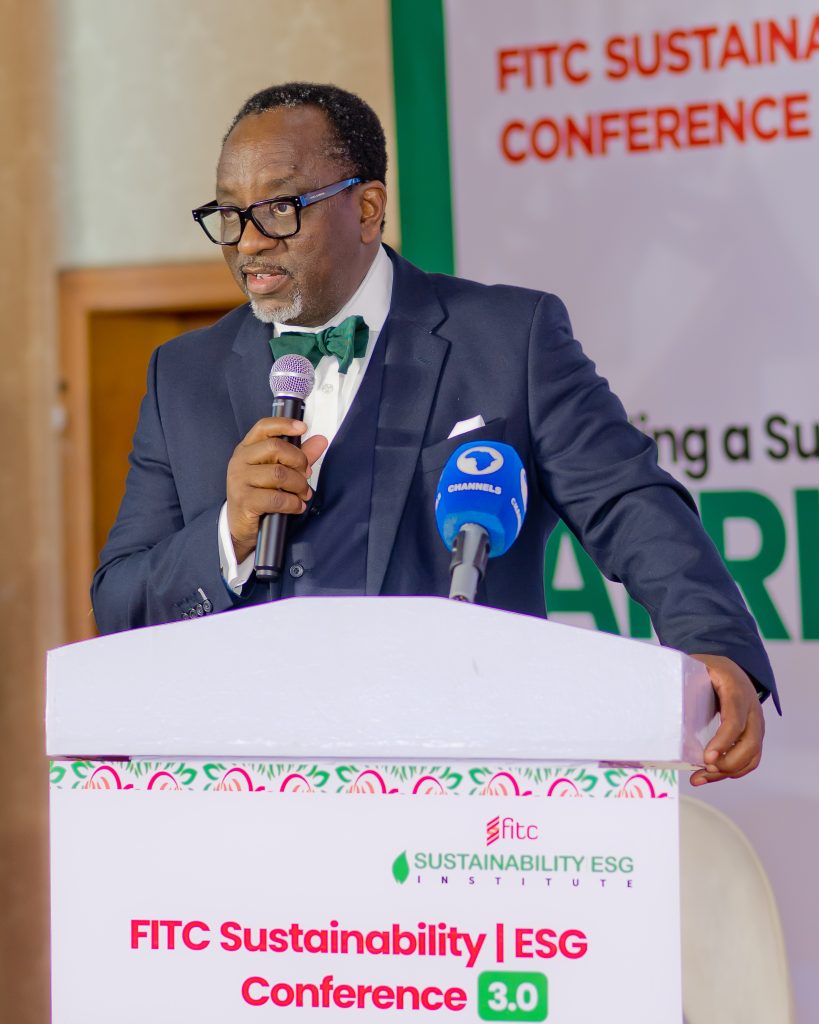
Those issues shaped discussions at the 2026 FITC Sustainability & ESG Conference held on July 8 at the Lagos Oriental Hotel, Victoria Island, Lagos. The conference, themed Building a Sustainable Africa: Integrating Environmental Stewardship, Social Impact and Strong Governance for a Prosperous Future, brought together policymakers, regulators, corporate leaders, sustainability professionals and financial institutions to examine how Africa can pursue economic growth while strengthening environmental responsibility, governance and social development.
Presenting one of the conference’s major papers, Professor Fabian Ajogwu, challenged one of the assumptions that has long shaped ESG conversations.
In a paper titled Environmental Stewardship or Environmental Compliance? Revisiting the Place of Governance in ESG, prepared with KENNA LP Associate Chiamaka Anakua and Research Associate Uyai-Abasi Etuk, Ajogwu argued that governance should not be viewed as the final pillar of ESG but as the foundation upon which environmental and social progress depends.
His position was direct.
“Governance is the foundational variable.”
Throughout the paper, Ajogwu argues that Africa’s biggest obstacle is not a shortage of sustainability policies or environmental commitments. Rather, it is the inability of institutions to consistently implement and enforce them.
He describes this as Africa’s sustainability paradox.
Although the continent contributes the least to global greenhouse gas emissions, it holds about 60 per cent of the world’s uncultivated arable land, according to the African Development Bank, alongside significant reserves of the critical minerals needed for renewable energy technologies and electric vehicles.
Yet much of that potential remains unrealised.
Africa continues to import large quantities of food despite its agricultural capacity, while exporting most of its mineral resources in raw form. Processing, manufacturing and value addition largely take place elsewhere.
For Ajogwu, the explanation lies not in the availability of natural resources but in the quality of governance surrounding them.
The paper extends that argument to Africa’s demographic realities. With the continent’s population projected to approach 2.5 billion by 2050, governments face increasing pressure to create jobs, strengthen education systems and build institutions capable of supporting inclusive economic growth.


