





…a million empty wrappers, 24 boreholes and 25,000 farmers: how Nestlé Nigeria is trying to make its environmental work last.
What if the wrapper of a drink could tell a different story after its contents were gone? Instead of ending up in a gutter, landfill or drainage channel, what if it could return as a school bag, lunch bag or pencil case? In Lagos, thousands of schoolchildren became part of an initiative built around that possibility, turning more than one million discarded MILO sachets into useful school items.
The exercise was part of Nestlé Nigeria’s MILO Elevate Recycling Initiative, organised in partnership with Rotaract District 9112 as part of its 2026 World Environment Day activities. More than 60,000 pupils across 100 primary schools participated, learning that environmental responsibility can begin with something as ordinary as an empty wrapper.
Beyond the collection figures, the initiative raised a broader question about Nigeria’s environmental challenges: how can responsible behaviour become part of everyday life rather than remain a message repeated during campaigns?
That question of what lasts runs through everything Nestlé Nigeria is doing on the environment. A clean-up ends by evening. A recycling habit, a borehole or a healthier field has to keep working for years. The company’s work on plastic, water and farming can be judged by that test.
Making Waste a Resource, Not a Burden
The MILO Elevate Recycling Initiative placed children at the centre of a practical waste-management exercise. Pupils deposited used wrappers in collection boxes provided at their schools, while teachers monitored submissions. The collected materials were then upcycled by Rotaract District 9112 into 1,013 items, including school bags, lunch bags and pencil cases, which were donated to schools and given as prizes to outstanding pupils.
For one pupil, Treasure John, the lesson extended beyond the classroom. She said the initiative helped her understand how improper waste disposal contributes to pollution and flooding, encouraging her to manage waste more responsibly. Her experience illustrates the value of connecting environmental education to problems children can recognise in their own communities. Stephen Avoseh of the Lagos State Universal Basic Education Board made the same point, saying that teaching through schools lets children pass what they learn to their families and communities.
But the real test is not the number of wrappers collected or products created. It is whether the experience changes disposal habits and supports systems that can recover waste.
Nestlé Nigeria has pursued wider partnerships to address plastic pollution. In June 2026, the company announced a multi-stakeholder environmental coalition involving government agencies, regulators, waste-management organisations, recyclers and industry platforms. The coalition is designed to strengthen waste recovery and promote circular-economy practices across 12 locations.
The company reported that collaboration with recycling partners, including Chanja Datti, Wecyclers and Maladase Ecopreneurs Management, had helped recover more than 60,000 metric tonnes of plastic since 2019. Its Employee Plastics Collection Scheme, introduced in 2022, had also recovered more than 12,000 kilogrammes.
These efforts recognise that manufacturers cannot address packaging waste independently of the systems responsible for collection, sorting, processing and reuse.
Bringing Water Security Closer to Communities
Plastic recovery addresses one dimension of environmental pressure, but water security presents another, with direct consequences for public health, livelihoods and community resilience.
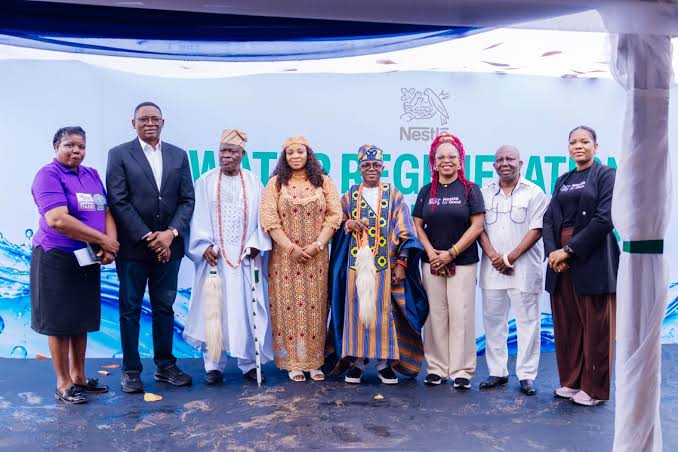
In October 2026, Nestlé Nigeria commissioned eight climate-smart boreholes and water treatment plants in communities within the Agbara catchment of Ogun State. The facilities form part of its Water Regeneration Project, which covers the Agbara catchment in Ogun State and the Abaji catchment in the Federal Capital Territory. Across the two catchments, the project includes 24 climate-smart boreholes, comprising eight in Agbara and 16 in Abaji, and the company says it amounts to about 400,000 cubic metres of water a year for communities.
At the commissioning, the Alagbara of Agbara, Oba Lukman Jayeola Agunbiade, highlighted the importance of safe water to children’s health, household dignity and family wellbeing. He also offered a reminder of the responsibility that comes with the project: “Agbara has received more than boreholes; we have received a responsibility.” He did not leave it as a figure of speech. He urged traditional leaders, community members and water, sanitation and hygiene committees to guard against misuse, report faults promptly and take ownership of the facilities.
The programme recognises that infrastructure alone cannot guarantee sustainable access. Community water, sanitation and hygiene committees, supported by governance training, are intended to strengthen local responsibility for the operation and maintenance of the facilities.
The Federal Government also emphasised the need to maintain the facilities beyond their commissioning. Minister of Water Resources and Sanitation, Professor Joseph Terlumun Utsev, noted that their success would ultimately depend on their continued ability to provide safe, reliable and sustainable services.
The project extends beyond infrastructure through the National Water Quality Advocacy Campaign and the National Water Quality Handbook, developed in collaboration with the Federal Ministry of Water Resources and Sanitation and the Organised Private Sector in Water, Sanitation and Hygiene (OPS-WASH).
Restoring the Land Through Agriculture
Environmental sustainability also reaches the farms that supply raw materials for food production. For smallholder farmers, changing weather patterns, declining soil health and other pressures can affect productivity, income and long-term livelihoods.
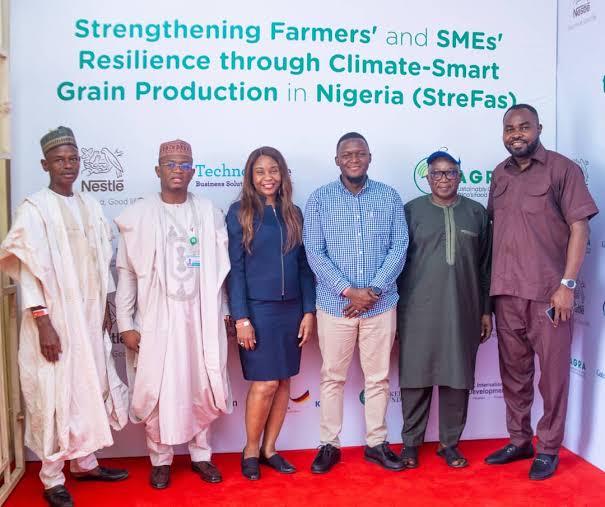
Nestlé Nigeria’s involvement in the Strengthening Farmers and SMEs Resilience through Climate-Smart Grain Production and Accessing Structured Markets (StreFaS) project connects farming with regenerative practices.
Implemented with AGRA and TechnoServe, the programme runs from June 2024 to October 2027 and aims to support 25,000 smallholder farmers and eight aggregators across Kaduna and Nasarawa States. Its focus crops include maize, rice, soybean and sorghum. Through farmer training, demonstration farms and market linkages, the project encourages practices intended to improve soil health, strengthen climate resilience and help farmers access structured markets.
At the project’s May 2025 launch, partners reported that it had engaged 12,373 farmers, 40 per cent of them young people, established 270 demonstration farms, supported regenerative practices across 1,853 hectares and aggregated more than 74,223 metric tonnes of produce.
Does it pay? One farmer says it does. Engineer Lawan Abdul, a soybean farmer from an earlier regenerative pilot, said “my yields have increased by 100 percent” after applying what he was taught.
In 2026, the project added a stronger reason to keep going. At an event in Zaria marking the International Day of Desertification and Drought, Nestlé Nigeria paid premium payments to farmers in Kaduna and Nasarawa who adopted regenerative practices during the 2025 planting season. A farmer who earns more for protecting the soil has a reason to carry on after the training ends. That is the link most green programmes are missing.
The Measure of Progress Is What Lasts
Across these activities, a common thread emerges: environmental responsibility requires more than awareness. It needs systems that enable participation, recover resources and allow communities to sustain the benefits.
That raises important questions about how corporate sustainability commitments should be judged. How much recovered plastic returns to productive use? Will the water facilities remain functional and provide safe water over time? Will farmers continue regenerative practices when programme support ends? And will the environmental lessons taught in schools translate into lasting changes in household behaviour?
Such questions do not diminish the value of the work. They set the standard by which it should be judged. Nestlé Nigeria has named locations, dates and numbers, which means the answers can be checked. The next test is making sure these systems keep working and keep delivering results long after the ceremonies are over.
For the pupils who collected more than one million MILO wrappers, the lesson began with an empty sachet. For communities receiving water facilities and farmers adopting regenerative practices, the stakes are broader. But the principle remains the same: what is discarded, depleted or neglected today will shape the environment and livelihoods of tomorrow.


