




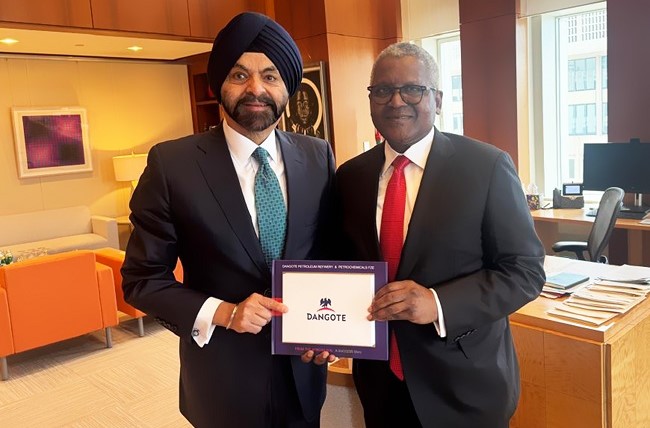
President of the Dangote Group, Aliko Dangote, has held a series of high-level bilateral meetings with global financial leaders on the sidelines of the 2026 Spring Meetings of the World Bank Group and International Monetary Fund, as part of efforts to mobilise investment into Nigeria’s energy and industrial sectors.
The engagements come amid growing global focus on sustainable development financing, infrastructure resilience and private sector-led growth across emerging economies.
Dangote met separately with Ajay Banga, Kristalina Georgieva and John Jovanovic, with discussions centred on unlocking capital for large-scale infrastructure, advancing macroeconomic reforms and strengthening trade and industrial capacity in Nigeria and across Africa.
At the meetings, Dangote also delivered the keynote address at the launch of the World Bank’s “Water Forward” initiative, a global programme designed to transform water systems into drivers of economic growth, job creation and climate resilience.
The initiative aims to improve water security for up to one billion people by 2030 by aligning policy reforms, financing and partnerships, while positioning water as a critical enabler of industrial productivity and sustainable development.
Speaking at the event, Dangote emphasised the role of private sector investment in scaling water infrastructure, noting that efficient water systems are essential not only for public health but also for industrialisation, food systems and energy security.
The launch drew participation from heads of government, multilateral development institutions and private sector leaders, reflecting rising urgency around water scarcity, which affects billions globally and increasingly constrains economic growth.
The engagements coincide with renewed momentum in Nigeria’s energy transition and industrial capacity. The country recorded a milestone in March 2026, becoming a net exporter of refined petrol for the first time in decades, driven largely by output from the Dangote Petroleum Refinery.
Analysts say the shift marks a significant step toward reducing import dependence, lowering emissions associated with fuel imports and strengthening domestic value chains within the energy sector.
Dangote Group’s long-term strategy, “Vision 2030,” further underscores this transition, with plans to expand refining capacity, scale fertiliser production and invest in infrastructure critical to industrialisation, including gas, power and logistics.
The broader context of the Spring Meetings highlights increasing pressure on developing economies to balance growth with sustainability. Global discussions in Washington have focused on inflation, energy shocks and the need for targeted financing to support reforming economies.
The annual meetings, which run from April 13 to 18, bring together policymakers, development partners and business leaders to deliberate on economic stability, climate resilience and pathways for inclusive and sustainable growth.
Analysts note that Dangote’s participation and high-level engagements signal a growing alignment between African industrial players and global development finance institutions, particularly in advancing sustainable infrastructure and climate-linked investments.


