




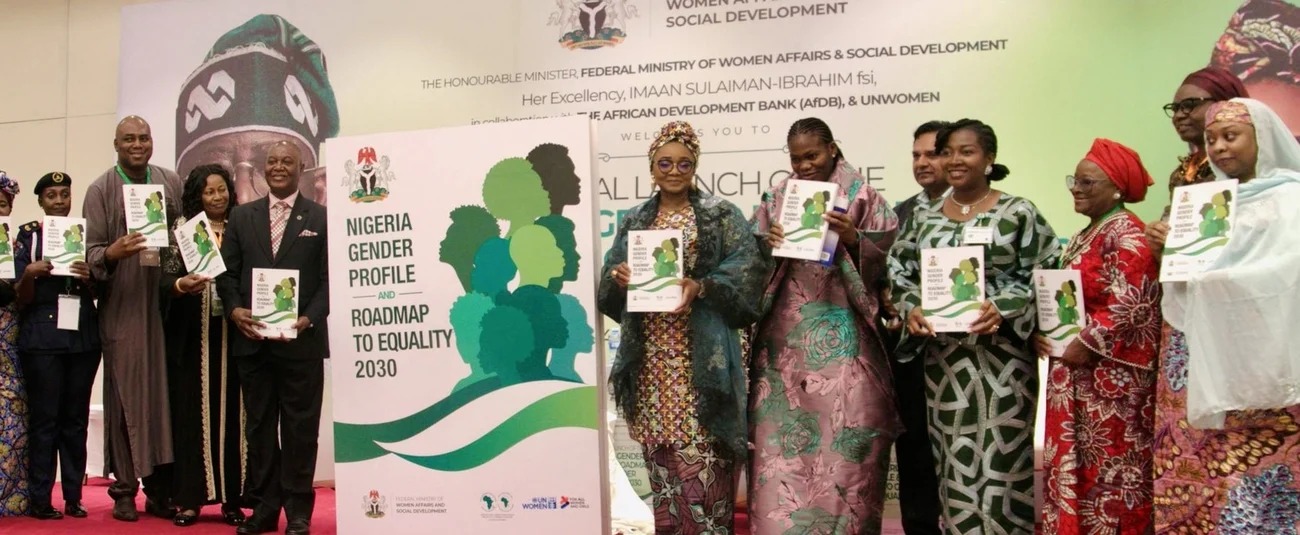
The African Development Bank (AfDB), the Federal Ministry of Women Affairs and Social Development, and UN Women Nigeria have launched the Nigeria Gender Profile and Roadmap to Equality 2030, a strategic framework designed to accelerate gender equality and promote inclusive economic growth across the country.
The framework, unveiled on June 24, brings together government institutions, development partners, the private sector, and civil society organisations to strengthen collaboration in advancing women’s empowerment and closing gender gaps across key sectors of the economy.
Developed under the African Development Bank Group’s Country Gender Profiles programme, the Nigeria Gender Profile provides an evidence-based assessment of gender disparities in critical areas, including economic participation, education, health, leadership, governance, and protection against gender-based violence. The accompanying Roadmap to Equality 2030 translates these findings into practical actions and institutional reforms aimed at delivering measurable progress over the next five years.
Unlike previous gender assessments, the new framework places strong emphasis on implementation. It combines detailed analysis of structural inequalities with a clear action plan that outlines priorities across eight strategic areas, providing government agencies and stakeholders with a practical guide for achieving gender-responsive development.
The report adopts a whole-of-economy approach, recognising that meaningful progress on gender equality requires coordinated interventions across sectors such as education, finance, infrastructure, governance, and social protection. It also underscores the need for sustained investment, stronger accountability mechanisms, and inclusive participation to achieve long-term impact.
Importantly, the framework aligns with Nigeria’s National Development Plan 2026–2030, ensuring that gender equality is integrated into national development priorities and public investment strategies.
Speaking at the launch, Nigeria’s Minister of Women Affairs and Social Development, Imaan Sulaiman-Ibrahim, described gender equality as an essential driver of national development.
“Gender equality is not a concession; it is a sound investment in the strength of our nation. When women and girls enjoy equal access to education, finance, leadership, and security, families are more stable, communities are more resilient, and the economy grows,” she said.
Also speaking, Dr. Abdul B. Kamara, Acting Vice President for Regional Development, Integration and Business Delivery and Director General for Nigeria at the African Development Bank Group, said the initiative reflects the Bank’s commitment to placing gender at the centre of economic development.
According to him, Nigeria is among the first countries where gender has been elevated from a cross-cutting issue to a strategic pillar within the Bank’s Country Strategy, stressing that gender equality should be viewed as a prerequisite for sustainable economic growth rather than a competing social objective.
The report was developed through extensive consultations involving stakeholders across Nigeria, including national experts whose contributions helped strengthen its technical quality and reinforce national ownership of the framework.
UN Women Representative to Nigeria and ECOWAS, Beatrice Eyong, noted that gender equality remains fundamental to achieving broader development outcomes.
She said gender equality cuts across economic transformation, democratic governance, human capital development, climate resilience, and sustainable peace, adding that accelerating gender equality also accelerates national development.
The Nigeria Gender Profile and Roadmap to Equality 2030 is aligned with the African Development Bank’s Gender Strategy 2021–2025, which has been extended through 2026, the Bank’s Nigeria Country Strategy Paper 2025–2030, and Nigeria’s National Development Plan 2026–2030. It also supports the country’s commitments under the Beijing Platform for Action, with its launch during the Beijing+30 milestone highlighting renewed commitment to implementation and measurable results in advancing gender equality.


