




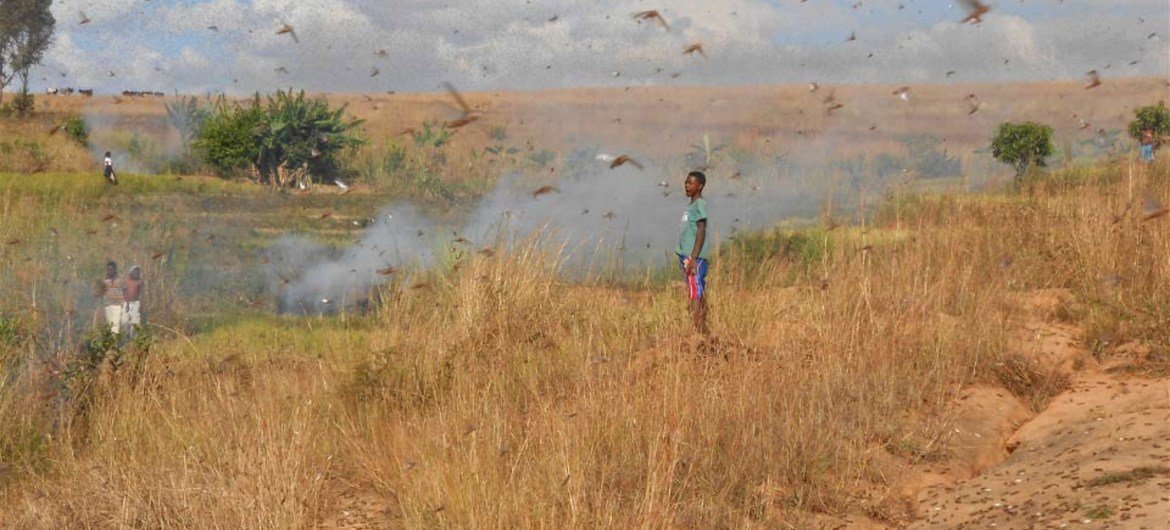
Madagascar has stepped up its fight against destructive locust invasions, launching the second phase of a national anti-locust campaign designed to protect food production and strengthen the resilience of rural livelihoods.
The new phase, inaugurated on recently in Toliara in the country’s drought-prone Atsimo-Andrefana region, aims to treat around 600,000 hectares of land threatened by active infestations.
The campaign forms part of Madagascar’s four-year Programme quadriennal de réponse à l’invasion acridienne (2024–2028), a framework that links emergency pest control with longer-term food security and environmental management goals. Through a combination of aerial spraying and targeted ground operations, authorities hope to contain swarms before they inflict widespread damage on crops and grazing areas.
Locust outbreaks have long been a recurring climate-linked risk in Madagascar, capable of wiping out harvests in a matter of days and pushing already vulnerable farming communities deeper into food insecurity. During the first phase of the programme in 2024–2025, nearly 300,000 hectares were treated by air, with additional areas covered by ground teams, helping to stabilise production in several key agricultural regions.
The expanded effort is backed by technical assistance from the Food and Agriculture Organization (FAO) and financing from the World Bank, with a total budget of about US$7.3 million. Funding is also being used to strengthen the Institut de lutte antiacridienne de Madagascar (IFVM), improving surveillance, training and operational capacity to enable faster, more precise responses to emerging swarms.
Government officials stress that the campaign goes beyond crisis management. By investing in early warning systems, institutional capacity and coordinated action, Madagascar is seeking to build long-term resilience to ecological shocks that are intensifying under climate change.
For rural communities, most of whom rely on rain-fed agriculture for income and food effective locust control can mean the difference between a stable season and severe loss. Authorities say careful management of pesticides to limit environmental and health impacts will remain central as operations expand, underscoring the campaign’s dual focus on protecting both food systems and ecosystems.


