




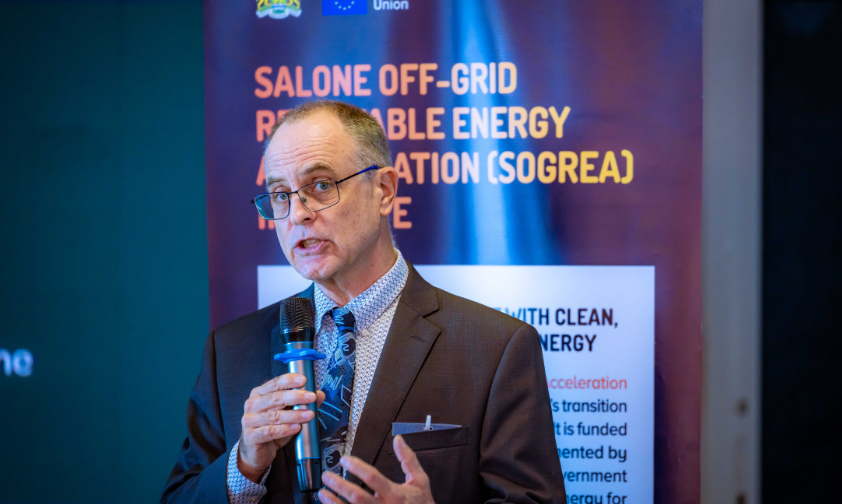
Sierra Leone has opened a call for private sector firms to develop and upgrade renewable energy mini-grids in rural and off-grid communities under a new €24 million programme funded by the European Union and the Government of Denmark.
The Salone Off-Grid Renewable Energy Acceleration (SOGREA) initiative aims to accelerate rural electrification, expand clean energy access and reduce dependence on costly diesel and kerosene power sources.
The three-year programme, launched on January 26 by the Government of Sierra Leone in partnership with Sustainable Energy for All (SEforALL) and the United Nations Office for Project Services (UNOPS), will provide catalytic performance-based capital support to cover portions of upfront development costs for eligible mini-grid projects. By reducing early-stage financial risk, SOGREA seeks to attract private capital into underserved markets that have traditionally struggled to finance projects on commercial terms.
Under the first Call for Pre-Qualification Applications, developers must be licensed, for-profit entities registered to operate in Sierra Leone with a track record of operating green mini-grids in sub-Saharan Africa. Firms must also demonstrate capacity to commission new projects within 12 months, integrate smart metering technology and ensure that at least 30 percent of their administrative and operational teams are women. Successful pre-qualified companies will later be invited to submit site-specific proposals.
The initiative builds on recent reforms in Sierra Leone’s mini-grid sector aimed at creating clearer rules for tariffs, licensing and private participation, which policymakers say are essential for long-term investment certainty in the country’s off-grid energy market.
Energy access remains a major challenge in Sierra Leone, where a significant portion of the population — particularly in rural districts — lacks reliable electricity. Limited power availability constrains economic activity, affects healthcare delivery and hampers educational opportunities outside daylight hours. Mini-grids powered primarily by solar energy with battery storage offer a decentralized alternative to traditional grid expansion in remote areas.
Energy Minister Cyril Arnold Grant said the EU-supported funding would support ongoing sector reforms and institutional capacity building while delivering improved energy access for rural communities. European Union Ambassador Jacek Jankowski underscored the need for strong government leadership and effective private sector partners to achieve sustainable rural electrification.
SOGREA is part of broader efforts across Africa to leverage blended finance for clean energy transitions in low-income markets, addressing both climate goals and development challenges in regions where energy poverty persists.


