




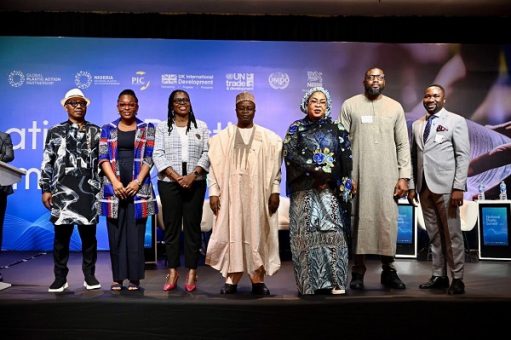
Stakeholders from government, industry, finance, development institutions, civil society and the private sector have called for urgent collaboration, increased investment and stronger policy implementation to tackle plastic pollution and accelerate Nigeria’s transition to a circular plastics economy.
The call was made at the opening of the National Plastic Summit 2026 in Abuja, convened by the Nigeria National Plastic Action Partnership (NPAP Nigeria) and hosted by the Policy Innovation Centre (PIC) with support from the Federal Ministry of Environment and the Global Plastic Action Partnership (GPAP) of the World Economic Forum. The summit was held under the theme, “Innovation, Inclusion and Investment for a Circular Plastics Economy in Africa.”
A major highlight of the summit was the inauguration of the Nigeria Plastics Financing Taskforce, a multi-stakeholder platform comprising representatives of development finance institutions, commercial banks, government agencies, industry players and civil society organisations. The taskforce is expected to develop strategies for mobilising investment and unlocking financing across Nigeria’s plastics value chain.
Organisers also unveiled plans for the Nigeria Plastic Action Financing Roadmap, which is being developed by NPAP Nigeria through the Policy Innovation Centre in partnership with PwC. The roadmap aims to identify financing gaps, map investment opportunities, recommend de-risking measures and propose practical financial instruments capable of scaling circular economy initiatives across the country.
Speaking at the summit, Executive Director of the Policy Innovation Centre, Dr. Osasuyi Dirisu, said investment remains central to advancing plastics circularity and transforming waste into economic value.
“We are not pursuing investment for the purpose of investing without returns; we are building the conditions for investment that deliver measurable returns for people, industry and the environment,” she said.
Dirisu noted that the initiative seeks to create opportunities across the entire plastics value chain, including for waste pickers, aggregators, recyclers and other informal-sector participants, while promoting jobs, livelihoods and inclusive economic growth. She stressed that plastic circularity should be viewed not merely as an environmental issue but as a development opportunity capable of driving industrial growth and innovation.
Head of the Global Plastic Action Partnership (GPAP) at the World Economic Forum, Clémence Schmid, described Nigeria as a pivotal player in Africa’s circular economy transition. According to her, the decisions and investments made in Nigeria today will shape regional markets, influence investment flows and determine the future trajectory of plastics circularity across the continent.
She emphasised that the next phase of Nigeria’s plastics agenda must focus on implementation through policy reforms, infrastructure development, business investment and measurable outcomes.
Declaring the summit open, Minister of Environment, Balarabe Abbas Lawal, represented by the Permanent Secretary of the ministry, Dr. Salihu Usman, described plastic pollution as one of Nigeria’s most pressing environmental, economic and public health challenges.
The minister disclosed that Nigeria generates more than 2.5 million tonnes of plastic waste annually, a significant portion of which ends up in rivers, oceans, farmlands and urban communities, contributing to flooding, environmental degradation and threats to public health.
“This is not just an environmental issue. It is a development issue. It affects agriculture, fisheries, tourism, public health and the overall quality of life in our communities,” he said.
Lawal called for stronger enforcement of environmental regulations, full implementation of Extended Producer Responsibility (EPR), increased investment in recycling infrastructure, greater public awareness and the adoption of innovative technologies to improve waste management systems.
The summit brought together policymakers, investors, manufacturers, recyclers, innovators, researchers, youth groups and informal-sector actors to explore practical pathways for plastics circularity as a driver of economic transformation, industrial competitiveness and sustainable development. Organisers said the event was designed around three key pillars: promoting circularity as an economic opportunity, strengthening policy implementation and financing mechanisms, and ensuring an inclusive and just transition that supports vulnerable workers and communities.
The gathering comes amid growing efforts by Nigeria and its development partners to address plastic pollution through circular economy initiatives, including investments in recycling infrastructure, sustainable plastic value chains and waste collection systems. Stakeholders expressed optimism that the summit would produce actionable partnerships and financing solutions capable of transforming plastic waste from an environmental burden into a source of jobs, enterprise development and green growth across Nigeria and Africa.


