




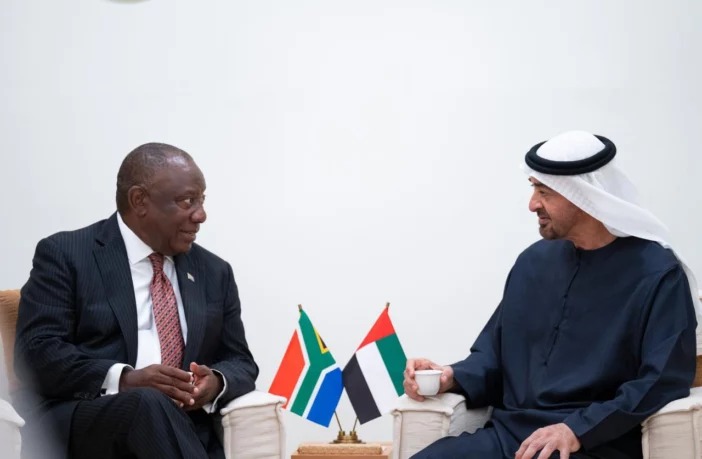
South African President Cyril Ramaphosa has positioned climate action as a central driver of economic growth and long-term competitiveness, using his address at Abu Dhabi Sustainability Week 2026 to argue that environmental responsibility and prosperity are increasingly inseparable.
Speaking to an audience of policymakers, investors and business leaders in the United Arab Emirates, Ramaphosa said countries that successfully align climate ambition with economic policy stand to unlock new sources of growth, innovation and employment. He cautioned that development pathways that ignore climate realities risk becoming economically obsolete, while climate strategies that fail to support livelihoods and industrial development may struggle to gain traction.
From a sustainability perspective, Ramaphosa framed climate action not as a constraint on growth, but as an opportunity to re-industrialise economies through cleaner, more resilient systems. He pointed to South Africa’s just energy transition as a case study, noting that the country has attracted more than R110 billion in clean energy investments by signalling policy certainty and committing to a low-carbon transition. According to the president, these investments are helping to stimulate innovation, modernise infrastructure and create new employment opportunities.
He also highlighted Africa’s broader potential in the global energy transition, describing the continent as a future hub for renewable energy production and export, given its abundant solar, wind and other clean energy resources. Emerging sectors such as renewable power and green hydrogen, he said, could play a critical role in addressing persistent challenges including unemployment, energy access gaps and infrastructure deficits.
Ramaphosa’s remarks were delivered alongside a series of bilateral meetings and investor engagements during his visit, aimed at deepening economic cooperation between South Africa, the UAE and international partners, particularly in sustainable finance and clean technology.
His intervention at the high-level forum reinforced a growing consensus at Abu Dhabi Sustainability Week: that well-designed climate strategies are no longer just environmental necessities, but strategic economic tools in an increasingly climate-conscious global economy.


